 Plan Your Trip Now
In This Guide
The Everest Base Camp Trek is the trek every serious hiker dreams about — and altitude is the single biggest factor that decides whether that dream goes smoothly or turns into a struggle. Most standard itineraries run 12 to 15 days, starting with a dramatic mountain flight into Lukla and ending at the foot of the world's tallest mountain. Along the way, the trail climbs through pine and rhododendron forest, Sherpa villages built into hillsides, and finally a stark, wind-scoured high-altitude world where oxygen is scarce and every step takes more effort than the last.
The Everest Base Camp Trek altitude tops out at Kala Patthar, 5,545 meters (18,192 ft), the viewpoint trekkers climb before dawn for the classic close-up of Mount Everest. Base Camp itself sits at 5,364 meters (17,598 ft). At either point, the air holds roughly half the oxygen available at sea level.
Unlike a technical climb, nothing on this trail requires ropes or crampons — the challenge is almost entirely physiological. As elevation builds day by day, breathing gets harder, sleep gets lighter, and appetite tends to fade. That's why a well-built Everest Base Camp itinerary spreads the climb out over nearly two weeks rather than rushing straight for the top. The route moves from Lukla (2,860 m) through Phakding, Namche Bazaar, Tengboche, Dingboche, and Lobuche before reaching Gorak Shep, the final overnight stop, from where trekkers push on to Base Camp and Kala Patthar.
If you're planning your trip, this guide walks through exactly where the elevation gain happens, where altitude sickness risk climbs fastest, and how to prepare so you reach Base Camp feeling strong rather than depleted.
What Is the Highest Point on the Everest Base Camp Trek?
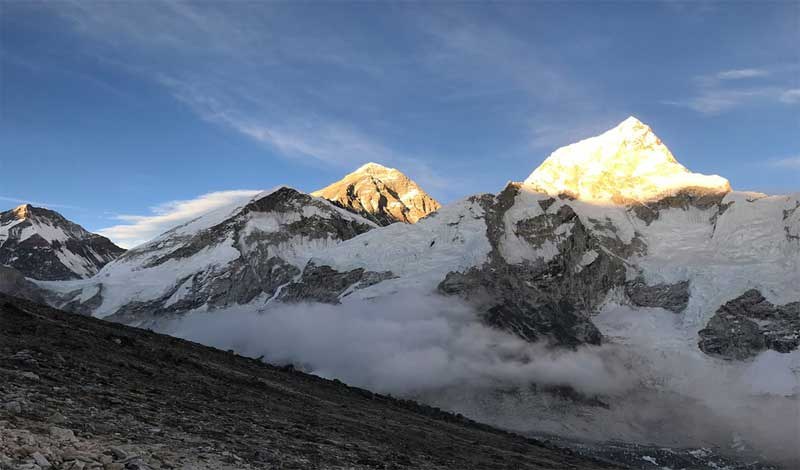
The highest point most trekkers actually stand on is Kala Patthar, at 5,545 meters (18,192 feet) — a rocky outcrop above Gorak Shep that delivers the single best panorama of Everest, Nuptse, and the Khumbu Icefall on the entire route. Everest Base Camp itself sits slightly lower, at 5,364 meters (17,598 feet), tucked beside the Khumbu Glacier at the foot of the mountain's notorious Icefall.
It's worth clearing up a common mix-up: Base Camp is where climbing expeditions stage their attempts on Everest, while Kala Patthar is purely a trekkers' viewpoint — no glacier travel, no crevasses, just a steep, lung-testing climb on a clear trail. Many itineraries visit Base Camp first (or the same day) and save the Kala Patthar sunrise hike for early the following morning, when the skies are calmest and the light on Everest's summit pyramid is at its best.
From Gorak Shep (5,164 m), the elevation gain to Kala Patthar is roughly 380 meters, and to Base Camp roughly 200 meters — modest distances that feel far harder than the numbers suggest, since both climbs happen above 5,100 meters, deep into the "extreme altitude" zone where even a slow, deliberate pace leaves most trekkers out of breath.
Everest Base Camp Trek Elevation Profile
A standard EBC itinerary begins with a short mountain flight from Kathmandu to Lukla, then follows the Dudh Koshi river valley north toward Namche Bazaar before climbing into the higher Khumbu villages. Here's the elevation profile of the key stops along the way:
| Location | Altitude (Meters) | Altitude (Feet) | Notes |
|---|---|---|---|
| Kathmandu | 1,350 | 4,430 | Arrival point before the flight to Lukla. |
| Lukla | 2,860 | 9,383 | Mountain airstrip; trek starts here. |
| Phakding | 2,610 | 8,563 | First overnight; gentle warm-up day. |
| Namche Bazaar | 3,440 | 11,286 | Sherpa hub; first major acclimatization stop. |
| Tengboche | 3,860 | 12,664 | Home to the region's most famous monastery. |
| Dingboche | 4,410 | 14,468 | Second dedicated acclimatization stop. |
| Lobuche | 4,910 | 16,109 | Last village before Gorak Shep. |
| Gorak Shep | 5,164 | 16,942 | Final overnight stop before the high points. |
| Everest Base Camp | 5,364 | 17,598 | Foot of the Khumbu Icefall. |
| Kala Patthar | 5,545 | 18,192 | Highest point trekkers reach on the route. |
Day-by-Day Elevation Gain on the Everest Base Camp Trek
Elevation on the EBC trail builds in a fairly consistent staircase pattern, broken up by two acclimatization stops that keep the ascent rate manageable. The table below shows a standard 13–15 day itinerary starting and ending in Kathmandu.
| Day | Trekking Route | Elevation | Net Elevation Change |
|---|---|---|---|
| Day 1 | Arrival in Kathmandu | 1,350 m | — |
| Day 2 | Fly to Lukla, trek to Phakding | 2,610 m | +1,260 m (mostly by air) |
| Day 3 | Trek to Namche Bazaar | 3,440 m | +830 m |
| Day 4 | Acclimatization in Namche (day hike higher) | 3,440 m | 0 m (day hike to ~3,880 m) |
| Day 5 | Trek to Tengboche | 3,860 m | +420 m |
| Day 6 | Trek to Dingboche | 4,410 m | +550 m |
| Day 7 | Acclimatization in Dingboche (day hike higher) | 4,410 m | 0 m (day hike to ~4,700–5,000 m) |
| Day 8 | Trek to Lobuche | 4,910 m | +500 m |
| Day 9 | Trek to Gorak Shep, hike to Everest Base Camp | 5,164 m / 5,364 m | +254 m to Gorak Shep, +200 m to Base Camp |
| Day 10 | Hike to Kala Patthar, descend to Pheriche | 5,545 m → 4,300 m | +381 m to summit, -1,245 m to Pheriche |
| Day 11 | Trek to Namche (via Tengboche) | 3,440 m | -860 m |
| Day 12 | Trek to Lukla | 2,860 m | -580 m |
| Day 13 | Fly back to Kathmandu | 1,350 m | -1,510 m (by air) |
Everest Base Camp Altitude Compared to the Annapurna Circuit
Trekkers weighing Nepal's two most famous high-altitude routes often want a direct comparison, and the numbers are genuinely close. Kala Patthar, at 5,545 meters, is the higher of the two trek high points; Everest Base Camp at 5,364 meters sits only just above Thorong La Pass on the Annapurna Circuit at 5,416 meters.
| Point | Everest Base Camp Trek | Annapurna Circuit Trek |
|---|---|---|
| Highest Point | 5,545 m (18,192 ft) at Kala Patthar | 5,416 m (17,769 ft) at Thorong La |
| Base Camp / Pass Altitude | 5,364 m (17,598 ft) | 5,416 m (17,769 ft) |
| Typical Overnight Max | 5,164 m (Gorak Shep) | 4,525–4,925 m (Thorong Phedi/High Camp) |
| Trek Duration | 12–15 days | 12–16 days |
| Acclimatization | Two dedicated rest days, at Namche and Dingboche | One rest day in Manang |
| Oxygen Level (approx.) | Roughly 50% of sea level | Roughly 50% of sea level |
| Altitude Sickness Risk | High, spread across several high nights | High, concentrated on pass-crossing day |
The real difference is exposure pattern rather than raw height. The Everest Base Camp Trek asks the body to sleep at extreme elevation for several consecutive nights, building tolerance gradually with two structured rest days. The Annapurna Circuit compresses its hardest altitude test into a single crossing day over Thorong La. Which style suits you better often comes down to whether you'd rather face a longer stretch at extreme altitude or one very long, very high single push.
How Does Everest Base Camp Altitude Compare to Other Himalayan Treks?
Among Nepal's classic trekking routes, the Everest Base Camp Trek sits near the very top of the altitude scale. Here's how it stacks up against other well-known treks in the region:
| Trek | Highest Point | Difference from EBC | Altitude Category |
|---|---|---|---|
| Everest Base Camp (Kala Patthar) | 5,545 m | — | Extreme |
| Poon Hill | 3,210 m | -2,335 m | Beginner |
| Annapurna Base Camp | 4,130 m | -1,415 m | Moderate |
| Mardi Himal | 4,500 m | -1,045 m | High |
| Gosaikunda Lake | 4,380 m | -1,165 m | High |
| Langtang (Tserko Ri) | 4,984 m | -561 m | Very High |
| Annapurna Circuit (Thorong La) | 5,416 m | -129 m | Extreme |
| Manaslu Circuit (Larkya La) | 5,160 m | -385 m | Extreme |
| Kanchenjunga Base Camp | Approx. 5,140 m | -405 m | Extreme |
| Gokyo Ri | 5,357 m | -188 m | Extreme |
Shorter, lower routes like Poon Hill or Mardi Himal make sense for trekkers with limited time or high-altitude experience. But if the goal is to stand at the base of the world's highest mountain and look up at Everest itself, no other trek in Nepal offers quite the same combination of altitude, scenery, and cultural depth — Sherpa villages, ancient monasteries, and a genuinely high-alpine finish.
Does Altitude Sickness Affect the Everest Base Camp Trek?
Yes — altitude sickness is a real concern on this route, and it's the main reason a proper itinerary matters more than raw physical fitness. Trekkers spend multiple nights above 3,500 meters and at least two nights above 4,900 meters, putting everyone at some risk of Acute Mountain Sickness (AMS).
Risk generally rises noticeably above Namche Bazaar and becomes most serious from Dingboche onward through Lobuche and Gorak Shep. Common symptoms include headache, nausea, dizziness, fatigue, loss of appetite, and disturbed sleep. Left unaddressed, these can progress toward High-Altitude Pulmonary Edema (HAPE) or High-Altitude Cerebral Edema (HACE), both of which require immediate descent.
Fitness alone doesn't prevent AMS — in fact, strong trekkers sometimes get into trouble precisely because they can move faster than their bodies are ready to acclimatize. Ascent rate, rest days, hydration, and honest self-monitoring matter far more than cardio fitness. If symptoms don't ease with rest, descending immediately is the only safe response, which is why comprehensive travel insurance covering high-altitude helicopter evacuation is essential for every trekker on this route.
Everest Base Camp Acclimatization
A properly built Everest Base Camp itinerary includes two dedicated acclimatization days — one in Namche Bazaar (3,440 m) and a second in Dingboche (4,410 m) — before continuing on toward Lobuche and Gorak Shep. On each rest day, trekkers hike up to a higher viewpoint (such as the Everest View Hotel above Namche, or Nangkartshang Hill above Dingboche) before returning to sleep lower down, following the standard "climb high, sleep low" principle that helps the body adjust without adding extra trekking days at maximum altitude.
The most demanding stretch of the entire trek is the final push from Gorak Shep to Everest Base Camp and, the following morning, up to Kala Patthar. At this elevation, a slow, deliberate pace matters far more than speed — rushing the final days is the single most common cause of altitude problems on this route.
If you'd like extra buffer built into your schedule, Team Ram Adventure can customize your Everest Base Camp Trek itinerary with additional rest days, particularly useful for first-time high-altitude trekkers or anyone trekking outside peak season.
How Difficult Is the Everest Base Camp Trek Because of Altitude?
The Everest Base Camp Trek is graded moderate to challenging, and altitude is the dominant reason why:
- Kala Patthar sits at 5,545 meters, where oxygen levels are roughly half of sea level — even short, gentle inclines can feel exhausting at that height.
- The trail gains elevation in a fairly steady staircase, but the days from Dingboche onward compress a larger share of the total ascent into the final third of the trek.
- Altitude sickness risk increases sharply above 4,000 meters; fitness does not prevent AMS, so symptom awareness matters more than pace.
- The stretch from Gorak Shep to Base Camp and Kala Patthar is the most physically taxing section, often tackled in pre-dawn cold for the best mountain views.
- Overnight temperatures near Gorak Shep and Lobuche regularly drop well below freezing, making proper cold-weather gear non-negotiable.
- Rushing the ascent past Namche or Dingboche significantly raises AMS risk — a steady pace, regular breaks, and good hydration matter more than speed.
- The two built-in acclimatization days are not optional extras; they're the backbone of a safe itinerary.
Fit, well-prepared trekkers generally complete the Everest Base Camp Trek comfortably with the right guide and pacing, but altitude remains the deciding factor for everyone, regardless of how many marathons or gym sessions they've logged beforehand.
How to Prepare for Everest Base Camp Altitude
No mountaineering skills are needed for this trek, but showing up in solid physical condition makes the high days at Dingboche, Lobuche, and Gorak Shep considerably more comfortable.
- Build cardiovascular fitness: Begin training weeks ahead with hiking, walking, stair climbing, and cycling. Pair cardio with leg and core strength work for the long uphill stretches and stone staircases along the trail.
- Ascend at a steady pace: Avoid rushing, especially from Namche onward. Walking slowly gives your body more time to adjust as the air thins.
- Stay hydrated: Aim for around 3–4 liters of water a day, more at higher camps, and carry a refillable bottle.
- Get proper rest: Sleep and rest breaks matter more at altitude — build in downtime at Namche, Dingboche, and Lobuche rather than pushing straight through.
- Know the symptoms of AMS: Headache, nausea, dizziness, and disturbed sleep are early warning signs. Stop ascending and tell your guide the moment they appear.
- Choose the right itinerary: Pick a schedule that includes both acclimatization days and sensible overnight elevation jumps rather than a compressed, rushed version of the trek.
Everest Base Camp Trek Altitude & Elevation Guide FAQs
1. What is the highest point on the Everest Base Camp Trek?
Kala Patthar, at 5,545 meters (18,192 feet), is the highest point trekkers reach. Everest Base Camp itself sits at 5,364 meters. Most trekkers visit Base Camp on Day 9 and climb Kala Patthar before dawn the following morning for the clearest mountain views.
2. What is the elevation gain on the Everest Base Camp Trek?
Trekkers fly into Lukla at 2,860 meters, climb to the 5,545-meter high point at Kala Patthar, then descend back to Kathmandu. Counting every up-and-down section of the trail, total cumulative elevation gain over the full round trip typically runs 7,000–8,000 meters.
3. What is the elevation of Namche Bazaar, the first acclimatization stop?
Namche Bazaar sits at 3,440 meters (11,286 feet). It's the Khumbu's main trading hub and the first mandatory rest day on a standard itinerary, giving trekkers a chance to explore the market, visit the Sherpa culture museum, or hike to the Everest View Hotel.
4. At what altitude does altitude sickness risk begin on this trek?
AMS risk starts becoming meaningful above roughly 2,500–3,000 meters, which on this route means from around Namche Bazaar onward. Risk climbs sharply above 4,000 meters, which is exactly why the itinerary schedules rest days at Namche and Dingboche.
5. What is a safe daily elevation gain to avoid altitude sickness?
The standard guideline is no more than 300–500 meters of sleeping-elevation gain per day once above 3,000 meters, with a rest day roughly every 1,000 meters of net climb. The Everest Base Camp itinerary is built around this exact principle.
6. How many days does it take to reach Everest Base Camp from Lukla?
Most standard itineraries take 8–9 days to reach Base Camp from Lukla, including two acclimatization days. Faster versions exist but meaningfully raise altitude sickness risk.
7. What is the elevation of Gorak Shep, the final overnight stop?
Gorak Shep sits at 5,164 meters (16,942 feet), the highest place trekkers sleep on the standard route. It's reached the day before the Base Camp and Kala Patthar push, and both hikes are done from here.
8. Which villages are the key altitude checkpoints along the route?
The commonly cited elevation checkpoints, from Lukla onward, are:
- Lukla – 2,860 m (trek start)
- Namche Bazaar – 3,440 m (first acclimatization stop)
- Tengboche – 3,860 m
- Dingboche – 4,410 m (second acclimatization stop)
- Lobuche – 4,910 m
- Gorak Shep – 5,164 m (final overnight)
- Everest Base Camp – 5,364 m
- Kala Patthar – 5,545 m (highest point)
9. Does altitude affect temperature on the Everest Base Camp Trek?
Yes, significantly — temperature drops roughly 6–7°C for every 1,000 meters gained. Near Gorak Shep and on the Kala Patthar sunrise hike, pre-dawn temperatures regularly fall well below freezing, even in the main spring and autumn trekking seasons, so layered clothing and a sub-zero-rated sleeping bag are essential.
10. Can I skip acclimatization days if I'm already fit?
No. AMS is caused by insufficient time for the body to adjust to lower oxygen levels, not by cardiovascular fitness — even very fit trekkers can develop symptoms if they climb too fast. The Namche and Dingboche rest days should be treated as fixed, non-negotiable parts of the itinerary.
Conclusion
At 5,545 meters on Kala Patthar, the Everest Base Camp Trek's altitude is genuinely demanding — but it's entirely achievable for trekkers who arrive reasonably fit, walk at a steady pace, and follow a properly acclimatized itinerary. Respecting the elevation gain from Namche Bazaar onward, and never rushing the final days into Dingboche, Lobuche, and Gorak Shep, is what separates a trek that feels hard-but-manageable from one that ends in a forced descent.
Few journeys on earth combine this much altitude with this much reward: Sherpa villages, the Tengboche monastery, glacier views, and finally the base of the world's highest mountain. Plan your Everest Base Camp Trek with Team Ram Adventure for an itinerary built around safe acclimatization, experienced Sherpa guides, and a pace that lets you actually enjoy the climb — not just survive it.
Ready to trek in the Himalayas?
Get itinerary guidance and local support from the Team Ram Adventure specialists.