 Plan Your Trip Now
In This Guide
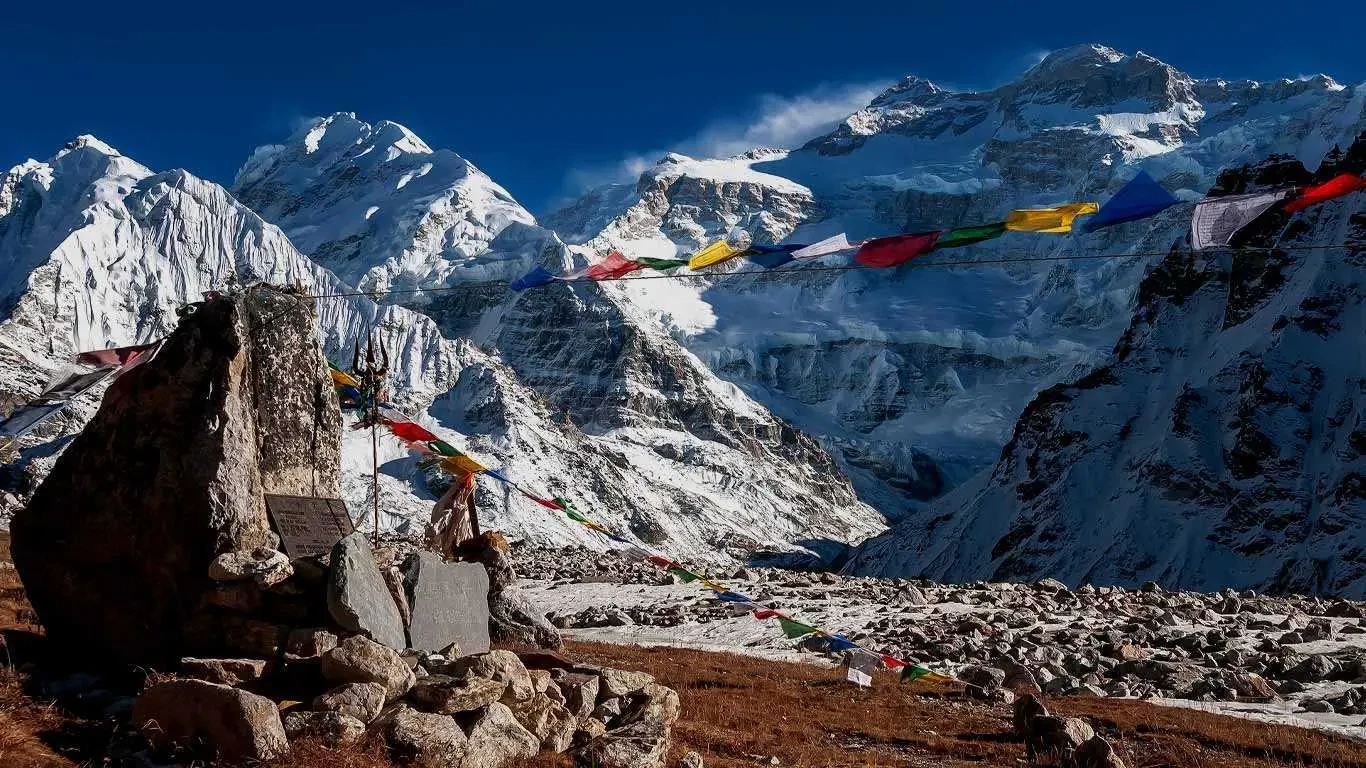
If you've done Everest Base Camp or the Annapurna Circuit and want something wilder, emptier, and far less commercialized, the Kanchenjunga Circuit Trek should be next on your list. This 21-day expedition circles Mount Kanchenjunga (8,586m) — the world's third-highest peak — taking you to both its North Base Camp (Pangpema, 5,143m) and South Base Camp (Oktang, 4,730m) in a single unforgettable journey.
This complete guide covers everything you need for 2026 or 2027: the full itinerary, real trip cost, difficulty level, required permits, best season, packing list, and the questions trekkers ask most before booking.
Quick Facts: Kanchenjunga Circuit Trek at a Glance
| Detail | Information |
|---|---|
| Duration | 21 Days |
| Trip Cost | From US$2,999 per person |
| Difficulty | Strenuous |
| Max Altitude | Pangpema / Kanchenjunga North Base Camp (5,143m) |
| Start / End Point | Kathmandu / Kathmandu |
| Accommodation | Teahouse/lodge, with camping in remote sections |
| Best Season | Spring (Mar–May) & Autumn (Sep–Nov) |
| Group Size | 2 to 16 people |
| Region | Eastern Nepal, Kanchenjunga Conservation Area |
Kanchenjunga Circuit Trek Highlights
Here's what makes this 21-day expedition one of Nepal's most rewarding wilderness treks:
- Two base camps, one trek — reach both Kanchenjunga North Base Camp (Pangpema, 5,143m) and South Base Camp (Oktang, 4,730m), a combination few other treks in Nepal offer.
- Mount Kanchenjunga itself — up-close views of the world's third-highest peak (8,586m), plus Jannu (Kumbhakarna) and other Himalayan giants.
- The Kanchenjunga Conservation Area — rich biodiversity with a real chance of spotting red pandas, snow leopards, Himalayan black bears, and blue sheep.
- Sele La Pass (4,290m) — a dramatic high-altitude crossing connecting the northern and southern valleys of the circuit.
- Remote Sherpa and Tibetan-influenced villages — Ghunsa, Gyabla, and Amjilosa offer prayer flags, monasteries, and genuine mountain hospitality far from any crowd.
- Rai and Limbu cultural immersion — lower-valley villages introduce trekkers to ethnic traditions rarely seen on the busier Everest and Annapurna routes.
- True off-the-beaten-path solitude — unlike Everest or Annapurna, the Kanchenjunga trail sees only a fraction of the foot traffic, offering genuine wilderness and quiet.
- Diverse terrain in one trip — subtropical forest, bamboo groves, alpine meadows, glacial moraines, and high mountain passes all in a single itinerary.
Why Choose the Kanchenjunga Circuit Trek?
With so many trekking routes across Nepal, here's why this one stands apart:
1. Two base camps most treks can't offer. Very few itineraries in Nepal let you visit both the north and south sides of an 8,000m peak. The Kanchenjunga Circuit does exactly that.
2. Genuine solitude. While Everest and Annapurna routes can feel like highways in peak season, Kanchenjunga's trails remain remote and quiet — ideal for trekkers who want to actually experience wilderness.
3. A serious credential for experienced trekkers. At 21 days and Strenuous grade, this is a trek for those who've already built up high-altitude trekking experience and want a genuine Himalayan challenge.
4. Rich, layered culture. From Rai and Limbu communities in the lower valleys to Sherpa and Tibetan-influenced villages higher up, the cultural diversity along this route is broader than most single treks offer.
5. Full logistics support from Team Ram Adventure. The package includes licensed English-speaking guides, porters (1 per 2 trekkers), all required permits, teahouse/lodge accommodation, full board meals, and a first aid kit carried by your guide — with acclimatization built into the schedule.
6. Flexible group sizes. With group sizes from 2 to 16 and both fixed departures and custom scheduling available, the trip can be tailored to your travel plans for 2026 and 2027.
Kanchenjunga Circuit Trek Difficulty
This trek is rated Strenuous. It's built for experienced trekkers with excellent physical fitness and prior high-altitude trekking experience. Expect:
- Long trekking days, often 6–7 hours, with some days stretching to 7–8 hours
- A high point of 5,143m at Pangpema (Kanchenjunga North Base Camp)
- Crossing Sele La Pass (4,290m) between the northern and southern circuits
- Remote terrain with basic infrastructure and limited rescue access compared to Everest or Annapurna
Acclimatization is built into the itinerary (notably the rest day at Ghunsa), but this trek demands real preparation — this is not a beginner's route.
Kanchenjunga Circuit Trek Itinerary (21 Days)
| Day | Route | Elevation |
|---|---|---|
| 1 | Arrival in Kathmandu & trek briefing | 1,400m |
| 2 | Fly to Bhadrapur, drive to Taplejung | 1,820m |
| 3 | Trek to Mitlung (4–5 hrs) | 921m |
| 4 | Trek to Chirwa (5–6 hrs) | 1,270m |
| 5 | Trek to Sukathum (5–6 hrs) | 1,576m |
| 6 | Trek to Amjilosa (6–7 hrs) | 2,308m |
| 7 | Trek to Gyabla (5–6 hrs) | 2,730m |
| 8 | Trek to Ghunsa (6–7 hrs) | 3,595m |
| 9 | Acclimatization day at Ghunsa | 3,595m |
| 10 | Trek to Kambachen (5–6 hrs) | 4,050m |
| 11 | Trek to Lhonak (5–6 hrs) | 4,780m |
| 12 | Trek to Pangpema (North Base Camp) & back to Lhonak (7–8 hrs) | 5,143m |
| 13 | Trek back to Ghunsa (6–7 hrs) | 3,595m |
| 14 | Trek to Sele La Pass (5–6 hrs) | 4,290m |
| 15 | Trek to Tseram (6–7 hrs) | 3,870m |
| 16 | Trek to Ramche & South Base Camp (6–7 hrs) | 4,580m |
| 17 | Trek back to Tortong (6–7 hrs) | 2,995m |
| 18 | Trek to Yamphudin (6–7 hrs) | 2,080m |
| 19 | Trek to Khebang (6–7 hrs) | 1,910m |
| 20 | Drive to Bhadrapur, fly to Kathmandu | 1,400m |
| 21 | Departure from Kathmandu | — |
Kanchenjunga Circuit Trek Cost 2026-2027
The package starts from US$2,999 per person (discounted from US$3,400).
What's Included
- Airport pick-up and drop-off in Kathmandu
- 2 nights hotel accommodation in Kathmandu with breakfast
- Domestic flights (Kathmandu–Bhadrapur–Kathmandu) or alternative transport
- Kanchenjunga Restricted Area Permit and Conservation Area Permit
- Licensed English-speaking guide and porter (1 porter per 2 trekkers)
- Teahouse/lodge accommodation during the trek
- All meals (breakfast, lunch, dinner) with tea/coffee during the trek
- First aid kit and safety equipment carried by the guide
- Government taxes and service charges
What's Excluded
- International flights to and from Nepal
- Nepal visa fees (obtained on arrival)
- Personal expenses (snacks, drinks, Wi-Fi, hot showers, battery charging)
- Travel insurance (must cover high-altitude trekking and helicopter rescue)
- Extra accommodation/meals beyond the itinerary due to delays
- Tips for guide and porter
- Emergency evacuation costs (unless covered by insurance)
- Costs from unforeseen circumstances (natural disasters, political unrest)
Permits Required for Kanchenjunga Circuit Trek
Because the Kanchenjunga region borders India and Tibet, it is a restricted area, and trekkers need two permits:
- Kanchenjunga Restricted Area Permit — mandatory for foreign trekkers in this border region.
- Kanchenjunga Conservation Area Permit — required for entry into the protected conservation zone.
Both permits are arranged by Team Ram Adventure and included in the trip cost. As a restricted area, solo trekking is not permitted — you must travel with a registered guide.
Best Time for the Kanchenjunga Circuit Trek
- Spring (March–May): Rhododendron forests in full bloom, pleasant weather, and lush greenery throughout the lower valleys.
- Autumn (September–November): The most popular season — stable weather, clear skies, and the best mountain visibility.
- Monsoon (June–August): Not recommended — heavy rainfall and leeches make the lower forested sections difficult.
- Winter (December–February): Extremely cold with heavy snowfall at altitude; not advisable for most trekkers.
Accommodation and Food on the Kanchenjunga Circuit Trek
- Accommodation: Basic teahouses and lodges along most of the route, with camping required in the most remote sections (such as near Lhonak and the base camps).
- Food: Nepali dal bhat, Tibetan bread, momos, soups, noodles, and simple continental dishes are available at most teahouses.
Flora, Fauna, People and Culture of the Kanchenjunga Region
Flora
The Kanchenjunga region moves through dramatic vegetation zones as you climb — from subtropical forests near Taplejung filled with sal and chestnut trees, through dense bamboo groves and rhododendron forests around Amjilosa and Gyabla, and finally into alpine meadows and sparse, hardy scrub near Lhonak and the base camps. Spring (March–May) is especially rewarding, when the rhododendron forests burst into bloom, painting entire hillsides red, pink, and white along the lower trail.
Fauna
The trek passes through the Kanchenjunga Conservation Area, one of Nepal's richest protected habitats, home to elusive and endangered species including red pandas, snow leopards, Himalayan black bears, and blue sheep. Birdlife is abundant too, particularly in the forested lower valleys, making this route a quiet favorite among wildlife spotters and birdwatchers — though sightings of the rarer mammals require patience and a bit of luck.
People
The lower valleys of the trek are home to the Rai and Limbu communities, indigenous ethnic groups known for their warm hospitality, distinct languages, and terraced farming traditions. As the trail climbs higher toward Ghunsa and Gyabla, the population shifts to Sherpa and Tibetan-influenced communities, whose lifestyles and livelihoods are closely tied to the high mountains and Buddhist monastic traditions.
Culture
Cultural life along the Kanchenjunga Circuit reflects this ethnic diversity, blending Hindu-influenced traditions in the lower hills with Tibetan Buddhist practices higher up — visible in the prayer flags, chortens, and monasteries found in villages like Ghunsa. Because the region remains far less visited than Everest or Annapurna, trekkers often experience these traditions in a more unfiltered, everyday form, from local festivals to simple teahouse hospitality that hasn't been shaped by mass tourism.
Essential Packing List for the Kanchenjunga Circuit Trek
Clothing: thermal base layers, fleece jacket, down jacket, waterproof jacket and pants, trekking pants and shirts, inner/outer gloves, warm hat, sun hat, hiking and thermal socks, trekking boots
Gear: 50–60L backpack, sleeping bag rated to -20°C, trekking poles, sunglasses, sunscreen, headlamp with extra batteries, water purification tablets/filters, personal first aid kit
Miscellaneous: snacks/energy bars, lightweight towel, camera and power bank, travel insurance documents (with high-altitude coverage)
Travel Insurance and Emergency Evacuation on the Kanchenjunga Trek
Of all the practical preparations for this trek, travel insurance is the one you genuinely cannot skip. The Kanchenjunga Circuit is one of the most remote trekking regions in Nepal, and that remoteness is exactly what makes proper coverage essential.
Why it matters more here than on other treks
Unlike Everest Base Camp or Annapurna, where helicopter access points and rescue infrastructure are relatively close by, much of the Kanchenjunga Circuit — especially the stretch between Ghunsa, Lhonak, and the two base camps — is genuinely hard to reach. If something goes wrong at 5,000m near Pangpema, help isn't a short flight away. Response times are longer, weather windows for helicopter access are narrower, and the nearest proper medical facilities are days of travel from the trail.
What your insurance needs to cover
- High-altitude trekking up to at least 6,000m — standard travel insurance policies often cap coverage around 3,000–4,000m, which won't cover this trek's 5,143m high point. Check the policy's altitude limit explicitly before buying.
- Helicopter rescue and evacuation — this is the single most important line item. Emergency evacuation from remote sections of this route can cost thousands of dollars if you're paying out of pocket.
- Medical treatment and hospitalization — covering both in-country treatment and, if needed, repatriation.
- Trip cancellation/interruption — useful given the long lead time and flight dependency (Kathmandu–Bhadrapur) built into this itinerary.
How rescue actually works on this trek
If a serious medical issue or severe altitude sickness occurs, your guide is typically the first line of response — trained in basic first aid and carrying communication equipment to coordinate a rescue. Where possible, the standard approach is to descend to a lower altitude immediately, since this is often the fastest way to relieve altitude sickness symptoms. If evacuation is necessary, your guide contacts a helicopter rescue service, but they typically require proof of insurance (or a guarantee of payment) before dispatching — which is why sorting this out before you leave home matters, not after you're on the trail.
Practical tips
- Buy insurance that names Nepal and high-altitude trekking specifically, not just generic "adventure travel" coverage.
- Carry a printed and digital copy of your policy documents and the insurer's emergency contact number.
- Register your trek dates and itinerary with your insurer or embassy if that service is available — it can speed up coordination in an emergency.
- Confirm with your trekking agency what communication equipment (satellite phone, radio) the guide carries on this specific route, since teahouse Wi-Fi becomes unreliable or unavailable past Ghunsa.
Given the cost of a single rescue flight, proper coverage is inexpensive insurance against a financially and physically devastating situation — this is one part of trek planning where cutting corners isn't worth the risk.
How to Prepare for the Kanchenjunga Circuit Trek?
1. Build your fitness 3–4 months in advance – Train with cardio (running, stair climbing, cycling), leg/core strength work, and long hikes with a loaded daypack on hilly terrain, since you'll walk 5–7 hours daily for three weeks.
Get prior high-altitude experience – If you haven't been above 4,000m before, do a shorter high-altitude trek in the year before Kanchenjunga to learn how your body handles altitude.
Book through a registered trekking agency – Kanchenjunga is a restricted border region, so solo trekking isn't legally allowed; you need a licensed guide to arrange your Restricted Area and Conservation Area permits.
Get travel insurance with helicopter evacuation cover – Make sure it explicitly covers high-altitude trekking (6,000m+) and rescue, since evacuation from this remote region is expensive without it.
Pack for a huge temperature range – Bring thermal base layers, a fleece, a down jacket, waterproofs, and a sleeping bag rated to -20°C, since the route goes from subtropical lowlands to glacier terrain.
Break in your trekking boots beforehand – Never wear new boots on a 21-day remote trek; worn-in boots prevent blisters that can derail your whole trip.
Learn acclimatization basics – Ascend gradually, hydrate well, avoid alcohol at altitude, and know early AMS symptoms (headache, nausea, fatigue); use the built-in rest day at Ghunsa fully.
Prepare for remoteness – Bring enough cash (no ATMs past Taplejung), expect basic teahouses near Lhonak, and set expectations with family about limited Wi-Fi and contact.
Do a full gear shakedown trip – Test your backpack, sleeping bag, boots, and layers on a multi-day trip beforehand so problems surface at home, not on day 3 of the trek.
Get a pre-trek medical check-up – Especially important given the strenuous grade and high altitude — confirm with a doctor that you're fit for sustained exertion above 5,000m.
Frequently Asked Questions
1. How difficult is the Kanchenjunga Circuit Trek?
It's rated Strenuous, with long trekking days (up to 7–8 hours), a maximum altitude of 5,143m, and a high-altitude crossing at Sele La Pass (4,290m). It's recommended only for experienced trekkers with strong fitness and prior high-altitude experience.
2. How many days does the Kanchenjunga Circuit Trek take?
The standard itinerary is 21 days, starting and ending in Kathmandu, though similar packages range from 18–21 days depending on the operator and route variation.
3. How much does the Kanchenjunga Circuit Trek cost?
The trek starts from US$2,999 per person, which includes permits, guide, porter, domestic flights, teahouse accommodation, and full board meals during the trek.
4. What permits are required for the Kanchenjunga Circuit Trek?
Two permits are mandatory: the Kanchenjunga Restricted Area Permit and the Kanchenjunga Conservation Area Permit. Both are arranged by your trekking agency and included in the cost.
5. What is the maximum altitude of the Kanchenjunga Circuit Trek?
The highest point is Pangpema (Kanchenjunga North Base Camp) at 5,143m. The South Base Camp at Oktang sits at 4,730m.
6. When is the best time to trek the Kanchenjunga Circuit?
Spring (March–May) and autumn (September–November) are the best seasons, offering stable weather and clear mountain views. Monsoon and winter are not recommended.
7. Can I trek the Kanchenjunga Circuit solo?
No — since the region is a restricted area, solo trekking is not permitted. You must trek with a licensed guide through a registered trekking agency.
8. Do I need a guide for the Kanchenjunga Circuit Trek?
Yes, a guide is mandatory due to the restricted area status, and strongly recommended regardless given the remote terrain, navigation challenges, and altitude risks.
9. Is Wi-Fi available during the trek?
Yes, Wi-Fi is generally available at every teahouse along the route, though speeds can be slow and connectivity may drop in the most remote sections.
10. What type of accommodation is available on the trek?
Trekkers stay in basic teahouses and lodges for most of the route, with camping required in remote high-altitude sections near Lhonak and the base camps.
11. What is the risk of altitude sickness on this trek?
Risk increases significantly above 4,000m, particularly around Kambachen, Lhonak, and Pangpema. The itinerary includes a built-in acclimatization day at Ghunsa, and guides carry first aid kits to monitor and manage symptoms.
12. How does the Kanchenjunga Circuit compare to Everest Base Camp or Annapurna?
The Kanchenjunga Circuit is longer, more remote, and considerably less crowded than EBC or Annapurna Circuit. It requires more trekking days, a restricted area permit, and greater physical preparation, but rewards trekkers with genuine solitude and two base camps instead of one.
13. What wildlife can I see on the Kanchenjunga Circuit Trek?
The route passes through the Kanchenjunga Conservation Area, home to red pandas, snow leopards, Himalayan black bears, and blue sheep, along with diverse birdlife.
14. What should I pack for the Kanchenjunga Circuit Trek?
Essentials include thermal base layers, a down jacket, a sleeping bag rated to -20°C, trekking poles, a 50–60L backpack, water purification tablets, and travel insurance with high-altitude coverage.
15. Do I need travel insurance for this trek?
Yes — travel insurance covering high-altitude trekking and helicopter rescue/evacuation is essential, given the trek's remoteness and the limited emergency access in the region.
Ready to Trek the Kanchenjunga Circuit?
The Kanchenjunga Circuit Trek is one of Nepal's last great wilderness adventures — two base camps, remote culture, and genuine solitude, all in one 21-day journey. With group sizes from 2–16 and flexible departures through 2026 and 2027, now is the time to plan your trip with Team Ram Adventure.
Book Your Kanchenjunga Circuit Trek or contact Team Ram Adventure for a custom itinerary.
Ready to trek in the Himalayas?
Get itinerary guidance and local support from the Team Ram Adventure specialists.