
 Plan Your Trip Now
In This Guide
If you're searching for a short, scenic, and unforgettable trek in Nepal's Annapurna region, the Ghorepani Poon Hill Sunrise Trek should be at the top of your list. Combining golden Himalayan sunrises, traditional Gurung and Magar villages, and lush rhododendron forests, this trek is one of the most popular short treks in Nepal — perfect for beginners, families, and anyone with limited time who still wants a genuine Himalayan experience.
In this guide, Team Ram Adventure breaks down everything you need to know: cost, required permits, difficulty level, and a full day-by-day itinerary.
Beyond the sunrise itself, this trek is a full sensory journey through the heart of the Annapurna foothills — winding stone-paved trails, terraced farmland, and dense forests that burst into color each spring. Along the way, you'll pass through warm, welcoming teahouses run by local families, offering a genuine taste of mountain hospitality that's hard to find on longer, more remote routes. It's this rare blend of accessibility and authenticity that keeps Ghorepani Poon Hill at the top of so many trekkers' Nepal itineraries, year after year.
Why Trek to Ghorepani Poon Hill?
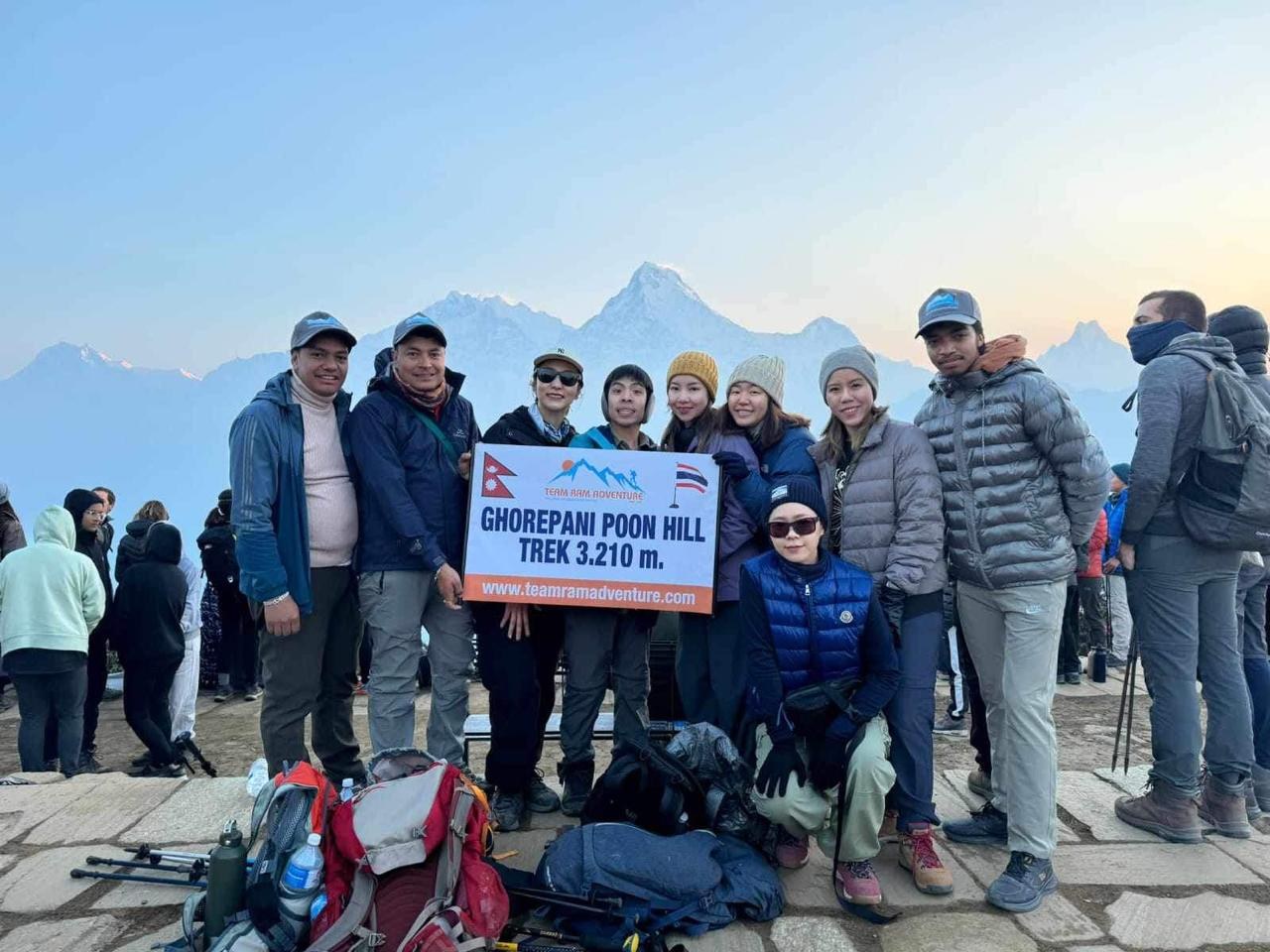
At 3,210 meters (10,531 ft), Poon Hill offers one of the most spectacular sunrise panoramas in the world — with unobstructed views of Annapurna South, Annapurna I, Dhaulagiri, Nilgiri, Machhapuchhre (Fishtail), and Hiunchuli, all lit up in gold and pink as the sun rises.
Beyond the sunrise, the trek offers:
- A short duration (typically 4–6 days), ideal for travelers with limited holiday time
- Low-altitude trekking, minimizing the risk of altitude sickness
- Immersive cultural experiences in Gurung and Magar villages like Ghandruk and Tikhedhunga
- Dense rhododendron and oak forests, especially spectacular in spring (March–April) when the national flower blooms
- A trail well-suited for beginners, families with children, and older trekkers
Ghorepani Poon Hill Trek Difficulty
The Ghorepani Poon Hill Trek is graded as easy to moderate, making it one of the most accessible treks in Nepal.
| Factor | Details |
|---|---|
| Maximum altitude | 3,210 m (Poon Hill) |
| Trek grade | Easy to Moderate |
| Daily walking hours | 4–6 hours per day |
| Altitude sickness risk | Low |
| Fitness level required | Basic to moderate fitness |
| Suitable for | Beginners, families, seniors |
| Trail type | Stone steps, forest trails, village paths |
Key difficulty notes:
- The trail involves a lot of stone staircases, especially the climb to Ulleri, which can be tough on the knees.
- No technical climbing or glacier crossing is involved.
- Because the maximum altitude stays around 3,210 m, altitude sickness is rarely a serious concern, though basic acclimatization habits (hydration, steady pace) are still recommended.
- A moderate level of fitness — regular walking, hiking, or stair-climbing beforehand — is enough to prepare.
- Anyone with a general love for walking and a reasonable level of health can comfortably complete this trek with proper pacing.
Permits Required for the Ghorepani Poon Hill Trek
Every trekker needs two mandatory permits to enter the Annapurna Conservation Area and complete the Poon Hill trek. These are checked at checkpoints along the trail (most notably at Birethanti), so you must carry them at all times.
1. Annapurna Conservation Area Permit (ACAP)
- Required for entry into the Annapurna Conservation Area
- Issued at the Nepal Tourism Board office in Kathmandu or the TAAN office in Pokhara
- Requires a copy of your passport and passport-sized photos
2. TIMS Card (Trekkers' Information Management System)
- A safety and tracking permit used to record trekker movement in the region
- Available as a Green TIMS (independent trekkers) or Blue TIMS (trekkers with a registered agency)
Permit Cost Table (2026)
| Permit | Foreign Nationals | SAARC Nationals |
|---|---|---|
| ACAP | NPR ~3,000 (approx. USD 25–30) | NPR 200–1,000 (approx. USD 2–10) |
| TIMS Card | NPR ~2,000 (approx. USD 15–20) | NPR 600 (approx. USD 5) |
| Total (Foreign) | ≈ USD 40–50 per person | — |
Important notes on permits:
- Permits are priced per trip, not per day — a 3-day or a 10-day trek costs the same.
- Permits cannot be arranged on the trail, so they must be sorted in Kathmandu or Pokhara before you start.
- If you book a guided trek with Team Ram Adventure, all permit arrangements (ACAP and TIMS) are handled for you — no paperwork, no queues, no stress.
Ghorepani Poon Hill Trek Cost (2026)
Trek cost depends heavily on whether you go independently or with a guided package, and what level of comfort you choose.
| Trek Style | Estimated Cost (per person) | What's Included |
|---|---|---|
| Independent (budget) | USD 200 – 350 | Permits, basic teahouse stays, self-arranged meals |
| Standard guided package | USD 350 – 600 | Permits, guide, teahouse accommodation, meals on trek, transport |
| Premium / Private trek | USD 700 – 1,200+ | All of the above + private transport, upgraded lodges, porter, added comfort |
What's typically included in a guided package:
- ACAP and TIMS permits
- Private transportation (Pokhara–Nayapul–Pokhara)
- A licensed, English-speaking trekking guide
- Porter service (optional, recommended)
- Teahouse/lodge accommodation throughout the trek
- All meals during the trek (breakfast, lunch, dinner)
What's usually NOT included:
- International/domestic flights
- Nepal visa fees
- Travel insurance
- Personal expenses (snacks, hot showers, Wi-Fi, charging, bottled/boiled water)
- Tips for guide and porter
Budgeting tip: Whichever route you choose, add a 15–20% contingency buffer to your budget for unexpected costs like weather delays, extra tea/snacks, or gear rental.
Best Time for the Ghorepani Poon Hill Sunrise Trek
| Season | Months | Conditions |
|---|---|---|
| Spring | March – April | Rhododendrons in bloom, clear mountain views |
| Autumn | October – November | Best visibility, stable weather, most popular season |
| Winter | December – February | Cold but clear skies, fewer crowds |
| Monsoon | June – September | Rainy, cloudy, least favorable for mountain views |
For the best sunrise views, October, November, March, and April are the ideal months, offering the clearest skies over the Annapurna and Dhaulagiri ranges.
Ghorepani Poon Hill Trek Itinerary — 8 Days (Kathmandu to Kathmandu)
Itinerary Overview Table
| Day | Route | Altitude | Trekking/Travel Hours |
|---|---|---|---|
| 1 | Arrival in Kathmandu (TIA) | 1,350 m | — |
| 2 | Kathmandu to Pokhara (tourist bus) | 822 m | 6–7 hrs drive |
| 3 | Drive to Nayapul, trek to Ulleri | 2,100 m | 1.5 hrs drive + 5 hrs trek |
| 4 | Ulleri to Ghorepani | 2,874 m | 6 hrs trek |
| 5 | Poon Hill sunrise hike, trek to Tadapani | 3,210 m (Poon Hill) / Tadapani | 6 hrs trek |
| 6 | Tadapani to Ghandruk | 2,000 m | 4 hrs trek |
| 7 | Ghandruk to Nayapul, drive to Pokhara | 822 m (Pokhara) | 4 hrs trek + 1.5 hrs drive |
| 8 | Drive back to Kathmandu (tourist bus) | 1,350 m | 6–7 hrs drive |
Detailed Day-by-Day Itinerary
Day 1: Arrival in Kathmandu (1,350 m)
Your adventure begins as you land at Tribhuvan International Airport (TIA) in Kathmandu. A Team Ram Adventure representative will greet you and transfer you to your hotel. The rest of the day is free to relax after your flight, explore the vibrant streets of Thamel, or attend a pre-trek briefing where your guide will walk you through the itinerary, packing essentials, and any last-minute questions. Overnight stay in Kathmandu.
Day 2: Kathmandu to Pokhara by Tourist Bus (822 m)
After breakfast, board a scenic tourist bus for the 6–7 hour drive to Pokhara, Nepal's lakeside gateway to the Annapurna region. The journey follows the Trishuli and Marshyangdi river valleys, offering glimpses of terraced hillsides and rural village life along the way. Upon arrival in Pokhara, enjoy sweeping views of the Annapurna range reflected in Phewa Lake. Use the evening to stroll along the lakeside, pick up any last trekking gear, and rest before hitting the trail. Overnight stay in Pokhara.
Day 3: Drive to Nayapul, Trek to Ulleri (2,100 m)
After an early breakfast, drive approximately 1.5 hours from Pokhara to Nayapul, the official starting point of the trek. From here, your trekking journey begins — the trail follows the Modi Khola river through Birethanti (where permits are checked) before climbing gradually through forest and farmland toward Ulleri village. This roughly 5-hour trek offers your first real taste of the trail, with mountain views beginning to open up as you gain elevation. Overnight in a teahouse in Ulleri.
Day 4: Ulleri to Ghorepani (2,874 m)
This is one of the more physically demanding days of the trek, involving a steady, steep climb through the famous stone staircases above Ulleri. The trail winds through dense rhododendron, oak, and magnolia forest — spectacular in bloom during spring — before reaching the charming village of Ghorepani. Perched at 2,874 m, Ghorepani offers your first uninterrupted panoramic views of the Annapurna and Dhaulagiri ranges. The approximately 6-hour trek ends with a well-earned rest and early dinner, since tomorrow begins before sunrise. Overnight in Ghorepani.
Day 5: Poon Hill Sunrise Hike, Trek to Tadapani (3,210 m → Tadapani)
Wake up well before dawn for the highlight of the trek: a roughly 45-minute uphill hike by headlamp to the summit of Poon Hill (3,210 m). As the sun rises, the sky lights up over Annapurna I, Annapurna South, Dhaulagiri, Nilgiri, Machhapuchhre (Fishtail), and Hiunchuli — one of the most celebrated sunrise views in the Himalayas. After soaking in the panorama and capturing photos, descend back to Ghorepani for breakfast, then continue trekking through peaceful forest trails toward Tadapani. The full day covers approximately 6 hours of trekking. Overnight in Tadapani.
Day 6: Tadapani to Ghandruk (2,000 m)
Today's roughly 4-hour trek takes you gently downhill through rhododendron forest into the traditional Gurung village of Ghandruk — one of the largest and most well-preserved ethnic villages in the Annapurna region. Spend the afternoon exploring stone-paved alleys, visiting the Gurung Museum to learn about local history and the Gurkha soldier heritage, and enjoying warm hospitality from the local community, all set against a backdrop of Annapurna South and Machhapuchhre. Overnight in Ghandruk.
Day 7: Ghandruk to Nayapul, Drive to Pokhara (822 m)
Your final trekking day takes you downhill from Ghandruk through terraced farmland and small villages back to Nayapul, approximately 4 hours of walking. From Nayapul, a 1.5-hour drive returns you to Pokhara, where a hot shower, comfortable bed, and lakeside restaurant await. This is also a good time to relax by Phewa Lake, treat yourself to a well-earned meal, and reflect on the trek with your guide and fellow trekkers. Overnight in Pokhara.
Day 8: Drive Back to Kathmandu by Tourist Bus (1,350 m)
After breakfast, board the tourist bus for the 6–7 hour scenic drive back to Kathmandu, retracing the route along the river valleys. Upon arrival, transfer to your hotel, with the rest of the day free for last-minute shopping in Thamel, sightseeing, or simply relaxing before your onward journey. This marks the end of your Ghorepani Poon Hill Sunrise Trek with Team Ram Adventure.
What to Pack for the Poon Hill Trek
- Sturdy, broken-in trekking boots
- Layered clothing (thermal base layer, fleece, waterproof jacket)
- Warm hat, gloves, and sunglasses
- Trekking poles (recommended for the stone-step sections)
- Headlamp (for the early sunrise hike)
- Reusable water bottle or hydration bladder
- Basic first-aid kit and personal medication
- Power bank (charging can be limited/paid on the trail)
Why Trek with Team Ram Adventure?
Choosing a trusted local operator makes a real difference on a trek like this — from permit handling to trail knowledge and safety.
- Experienced, licensed local guides who know the region intimately
- Full permit arrangement (ACAP and TIMS) handled on your behalf
- Comfortable teahouse accommodations and reliable itineraries
- Flexible trip durations to match your schedule
- Genuine support for local Gurung and Magar communities along the route
Ready to watch the sunrise over the Annapurna range from Poon Hill? Explore the full trip details, itinerary options, and booking information on the Ghorepani Poon Hill Sunrise Trek page with Team Ram Adventure.
Ghorepani Poon Hill Trek: FAQs
1. How difficult is the Ghorepani Poon Hill Trek?
The trek is rated easy to moderate, making it one of the most accessible treks in the Annapurna region. The trail involves daily walks of 4–7 hours on well-maintained paths, forest trails, and stone staircases — the steepest section being the climb up to Ulleri, which consists of thousands of stone steps. No technical climbing, ropes, or glacier crossings are involved. Anyone with a reasonable level of fitness — someone who walks or hikes regularly — can comfortably complete it. Because the highest point (Poon Hill, 3,210 m) stays well below serious high-altitude zones, this trek is often recommended as a first trek in Nepal or a warm-up before attempting longer routes like Annapurna Base Camp or Everest Base Camp.
2. What permits do I need, and how much do they cost?
You need two mandatory permits: the Annapurna Conservation Area Permit (ACAP) and the TIMS Card (Trekkers' Information Management System). Together, they cost approximately USD 40–50 per person for foreign nationals (roughly NPR 3,000 for ACAP and NPR 2,000 for TIMS), with reduced rates for SAARC nationals. Both permits are checked at trail checkpoints, most notably at Birethanti, and must be arranged in advance in Kathmandu or Pokhara — they cannot be purchased along the trail. When you book with Team Ram Adventure, both permits are arranged for you as part of the package.
3. How much does the entire trek cost?
Total cost depends on your trekking style. Independent budget trekkers can expect to spend USD 200–350 per person, covering permits, basic teahouse stays, and self-funded meals. A standard guided package — including permits, guide, porter, accommodation, meals, and transport — typically runs USD 350–600 per person. Premium or private treks with upgraded lodges and dedicated transport can range from USD 700–1,200+. It's wise to add a 15–20% contingency buffer to any budget for weather delays or extra trail purchases like snacks, hot showers, and charging fees.
4. How many days does the trek take?
Most itineraries run 4 to 6 days, including transport from Pokhara and back. A fast-paced version can be completed in as few as 3 days, while a more relaxed itinerary with extra villages (like Ghandruk) stretches to 5–6 days. The core walking days involve reaching Ghorepani, hiking up to Poon Hill for sunrise, and looping back down through forest and village trails to Nayapul.
5. Do I need a guide, or can I trek independently?
Technically, the trail is well-marked and busy enough that experienced trekkers can go independently. However, a licensed guide is strongly recommended — they handle permit checkpoints, know the fastest and safest paths, offer cultural context in the villages you pass through, and can respond quickly if anything goes wrong. Solo trekkers must still carry a TIMS card (Green TIMS) even without a guide. Trekking with a registered agency like Team Ram Adventure also means a Blue TIMS card is arranged on your behalf.
6. What is the best time of year to do the Poon Hill Trek?
The two best seasons are autumn (October–November) and spring (March–April). Autumn offers the clearest, most stable skies and is the most popular season overall. Spring brings blooming rhododendron forests — Nepal's national flower — alongside good visibility. Winter (December–February) is cold but often clear, with fewer crowds on the trail. Monsoon season (June–September) is the least favorable, with frequent rain, leeches on lower trails, and clouds that often obscure the sunrise views Poon Hill is famous for.
7. Can I see Mount Everest from Poon Hill?
No. This is one of the most common misconceptions about the trek. Poon Hill's viewpoint faces the Annapurna and Dhaulagiri ranges, offering panoramic views of Annapurna I, Annapurna South, Dhaulagiri, Nilgiri, Machhapuchhre (Fishtail), and Hiunchuli. Everest is located far to the east and is not visible from this viewpoint. If Everest views are your priority, treks like Everest Base Camp or the Gokyo Lakes route are better suited.
8. Is the trek safe for beginners, families, and older travelers?
Yes — this is one of the main reasons Poon Hill is so popular. With low altitude, moderate daily walking hours, and comfortable teahouse accommodation along the entire route, it's considered family-friendly and suitable for older travelers or first-time trekkers. That said, the stone steps (especially near Ulleri) can be tough on knees, so trekking poles are recommended, and a realistic pace should be planned for children or less experienced walkers.
9. What kind of accommodation and food are available on the trail?
The trek passes through well-established teahouses and guesthouses in villages like Tikhedhunga, Ulleri, Ghorepani, Tadapani, and Ghandruk. Rooms are typically basic — twin-share with shared bathrooms in most lodges, though some in Ghorepani and Ghandruk offer attached bathrooms at a higher price. Meals are largely Nepali-style: dal bhat (rice, lentils, vegetables) is the trekker staple, alongside soups, noodles, pasta, and basic Western dishes like pancakes or porridge for breakfast. Bottled water, hot showers, Wi-Fi, and device charging are usually available but cost extra as you gain altitude.
10. What should I pack for the Ghorepani Poon Hill Trek?
Essential packing items include sturdy, broken-in trekking boots, layered clothing (thermal base layer, fleece, and a waterproof outer shell), a warm hat and gloves for the early sunrise hike, trekking poles for the steep stone-step sections, a headlamp for the pre-dawn climb to Poon Hill, a reusable water bottle, a basic first-aid kit, and a power bank since charging can be limited or paid for on the trail. Since the trek stays at relatively low altitude, heavy high-altitude gear (down suits, oxygen, etc.) is not necessary.
Final Thoughts
The Ghorepani Poon Hill Sunrise Trek remains one of Nepal's most rewarding short adventures — offering world-class Himalayan sunrise views, rich cultural encounters in Gurung and Magar villages, and a manageable difficulty level that welcomes beginners, families, and seasoned trekkers alike, all without the time commitment or altitude risks of longer expeditions. With permits sorted (ACAP and TIMS), a realistic budget in place, and the right season chosen, this trek delivers an unforgettable Himalayan experience in just a handful of days. If you're ready to watch the sun rise over Annapurna and Dhaulagiri from 3,210 meters, Team Ram Adventure is ready to guide you every step of the way.
Ready to trek in the Himalayas?
Get itinerary guidance and local support from the Team Ram Adventure specialists.